
If you work as an independent software developer, UI/UX programmer, or IT contractor in India, you are classified as a sole proprietor. Under Section 44ADA, you can legally declare exactly 50% of your gross earnings as profit and pay tax only on that half. Here is the no-nonsense guide to keeping your money.
Most local CAs do not understand modern freelance developer workflows. They will treat you like a manufacturing factory, demanding you keep paper bills for electricity, print tea receipts, and track office supplies. Stand your ground: if you earn under Rs. 75 Lakhs, tell your CA to file under Section 44ADA. If you want to make sure your filing is bulletproof and avoids audit flags, read our Section 44ADA tax audit survival guide before filing.
Let me share how I learned about the reality of corporate margins. I graduated with a B.Tech in 2018 and was immediately recruited by a Tier-1 Indian tech consulting conglomerate in Bangalore. Put on a massive US enterprise project, I was working 60-hour weeks. The turning point came when I accidentally saw the project's billing sheet. The firm was billing the US client $150/hour (approx. Rs. 12,000/hour) for my full-time labor, while paying me a monthly salary of exactly Rs. 35,000 (roughly Rs. 145/hour). I resigned in 2021 to go freelance, starting from a cramped 1BHK in HSR Layout.
Traditional IT service agencies are modern labor arbitrage masquerading as prestige. Paying an engineering graduate Rs. 24,120 a month while billing a European client $80/hour for their labor is exploitation. If you are in one, your primary job is to build an escape pod (independent profiles, digital portfolio) on the weekends. Read our guide on how to get remote US jobs from India to start finding clients directly.
---
The Presumptive Taxation Hack: Section 44ADA
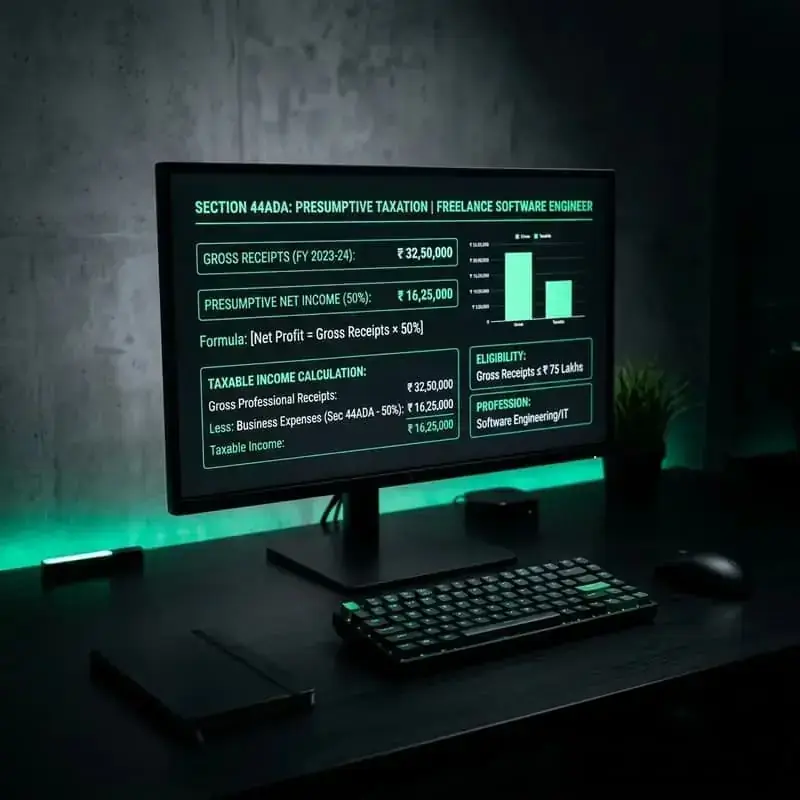
Section 44ADA is a simplified taxation scheme designed specifically for professionals. Instead of maintaining complex ledgers, balance sheets, and depreciation schedules under Section 44AA, the government presumes your business expenses are exactly 50% of your gross receipts.
For example:
- Gross Invoices Raised: Rs. 40,00,000 (Rs. 40 Lakhs)
- Presumed Expenses (50%): Rs. 20,0,000 (Rs. 20 Lakhs)
- Net Taxable Business Profit: Rs. 20,0,000 (Rs. 20 Lakhs)
If you file under the New Tax Regime, your tax liability on Rs. 20 Lakhs is computed using standard slabs, saving you lakhs. You can legally spend your money on rent, gadgets, or travel without keeping receipts. The legal upper limit to utilize this scheme is Rs. 75,00,000 (Rs. 75 Lakhs) per fiscal year.
---
ITR Forms Demystified: Filing ITR-4 vs. ITR-3
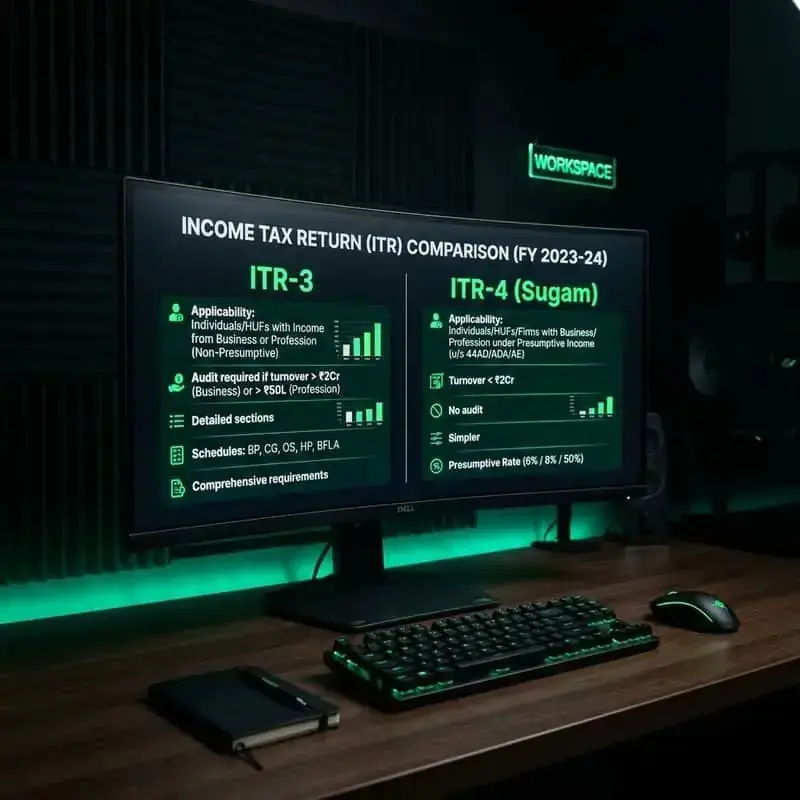
When filing your annual return, choosing the correct form is critical to avoid receiving discrepancies notices:
- ITR-4 (SUGRIAM): Use this form if you declare presumptive income under Section 44ADA and your total taxable income is under Rs. 50 Lakhs. It is a simple, 4-page return that does not require balance sheets.
- ITR-3: You must file ITR-3 if your gross receipts exceed Rs. 50 Lakhs, if you own equity shares in unlisted companies, if you have capital gains from mutual funds or stocks, or if you want to carry forward business losses.
Most developers filing under Section 44ADA will end up using ITR-3 because they invest in mutual funds. Make sure your CA enters the correct business code: 09115 (Software Development) or 09116 (Computer consultancy and allied services). For official instructions, you can refer to the Income Tax Department ITR Guide.
---
GST Compliance: When Does a Developer Need It?
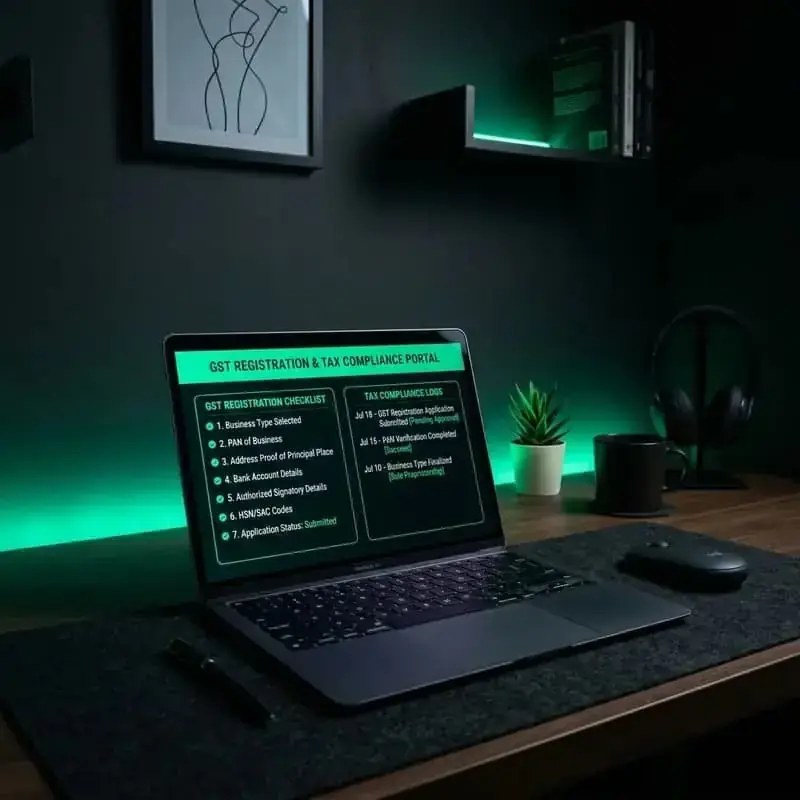
Income tax and GST are separate legal systems. You must track your thresholds for both:
- Under Rs. 20 Lakhs: If your total annual receipts are under Rs. 20 Lakhs, you do not need GST registration, even if you bill USD clients.
- Over Rs. 20 Lakhs: You must register for GST once your gross receipts exceed Rs. 20 Lakhs. If you export code or services to international startups, your GST rate is 0% (Zero-Rated), but you must file a free Letter of Undertaking (LUT) on the portal before billing. You can submit your LUT directly on the Official GST Portal.
Failing to file an LUT before receiving USD is financial negligence. If you bill USD clients without it, the tax department can retroactively demand an 18% IGST on your total invoices. Read our full GST Export Trap guide to set up your zero-rated compliance correctly.
---
Three Legitimate Deductions to Cut Your Tax to Zero
Even if you declare only 50% profit under Section 44ADA, you can use these strategies to optimize your final tax outgo:
- The New Tax Regime Slab Rebate: Under the New Regime, if your final taxable income is under Rs. 7,00,000 (Rs. 7 Lakhs), you receive a rebate under Section 87A, making your tax liability exactly zero. This means you can earn Rs. 14 Lakhs gross, show Rs. 7 Lakhs profit, and pay Rs. 0 tax.
- Health Insurance (Section 80D): If you stick to the Old Tax Regime, you can claim up to Rs. 25,000 for self/family and Rs. 50,000 for parents' health policies.
- PPF and ELSS (Section 80C): Deduct up to Rs. 1,50,000 (Rs. 1.5 Lakhs) by investing in public provident funds or equity-linked savings schemes.
When receiving international wire transfers, don't let banks eat your margins. Standard banks hide a 2.5% markup in the exchange rate. Use modern multi-currency platforms to receive USD/EUR. Read our freelance banking fees audit to stop the bank conversion leak, and if you want to build high-converting landing pages for your own products, explore our B2B SaaS copywriting services.