
Invoicing international clients from India classifies your work as an Export of Services. Under the Integrated Goods and Services Tax (IGST) Act, service exports are zero-rated supplies, meaning you owe zero tax. However, you must submit a free Letter of Undertaking (LUT) on the GST portal before issuing invoices to claim this exemption legally.
Most local CAs do not understand digital freelance transactions. They are trained for domestic brick-and-mortar retail shops. They will tell you to ignore GST until you make Rs. 20 Lakhs, or they will tell you to pay 18% tax and claim a refund. Both routes are wrong. If you export services and cross Rs. 20 Lakhs in gross annual receipts, you must register, file your free LUT, and declare your earnings. Read our guide on tax on international freelance income in India to understand the general tax framework.
Failing to file an LUT is financial negligence. If you invoice USD clients without filing a free, 5-minute LUT on the GST portal before exporting or billing, you are exposing yourself to a retrospective 18% tax demand. The tax department will eventually notice, and interest charges will stack up.
Let me share a story about how this plays out when you ignore compliance. An independent UI/UX designer from Pune named Priya reached out to me in tears after receiving an official tax demand notice from the GST department. She was billing US startups for remote design work, earning Rs. 24,00,000 (Rs. 24 Lakhs). Since she was exporting services, she assumed GST did not apply to her. However, because she had not filed a Letter of Undertaking (LUT) on the GST portal before issuing invoices, the GST department slapped her with a retrospective tax demand of 18% IGST on her total gross earnings, plus interest and penalties. She had to hire a tech-forward CA to represent her case and retroactively submit proof of foreign inward remittances (FIRA). While they resolved the main tax demand, Priya still had to pay a hefty compliance penalty that wiped out her savings.
---
The Zero-Rated Supply Rule: What Counts as Export of Services?
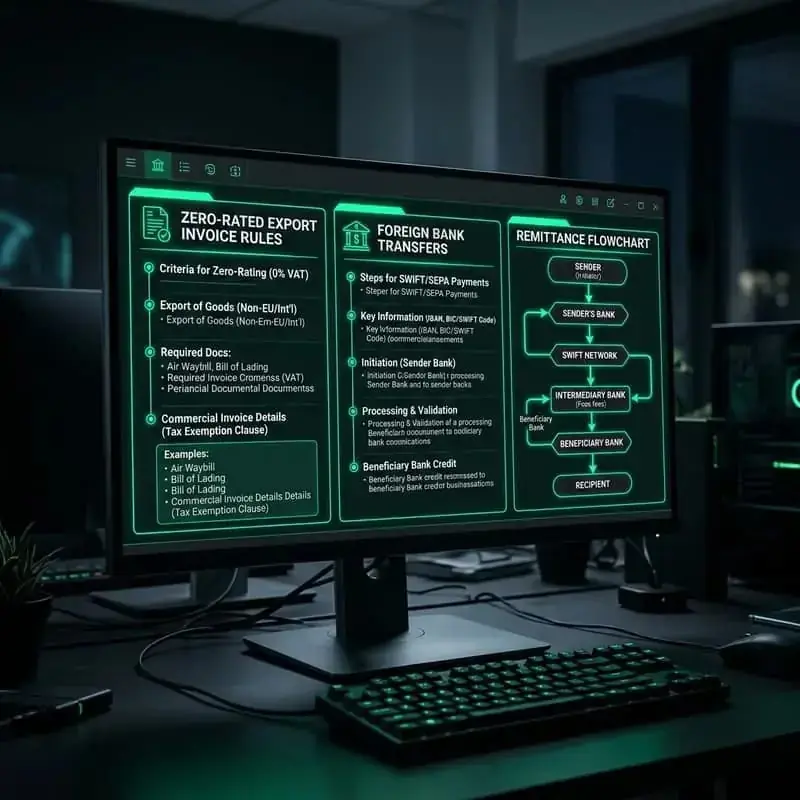
To legally invoice USD/EUR clients at a 0% GST rate, your freelance work must satisfy five conditions under Section 2(6) of the IGST Act:
- Provider Location: You must be physically located in India.
- Recipient Location: Your client must be physically located outside India.
- Place of Supply: The service must be consumed outside India.
- Payment Mode: You must receive the payment in convertible foreign exchange (USD, EUR, GBP) in your bank account.
- No Common Entities: You and your client are not merely branches of the same corporate entity.
Once you cross the standard limit of Rs. 20,0,000 (Rs. 20 Lakhs) gross annual receipts, GST registration is legally mandatory. You must submit your registration application online via the Official GST Portal.
---
Step-by-Step: Filing the RFD-11 LUT on the GST Portal

Filing the Letter of Undertaking (LUT) takes less than five minutes and is entirely free. Follow these steps at the start of every fiscal year:
- Log into the Official GST Portal.
- Navigate to Services > User Services > Form GST RFD-11.
- Select the financial year you are filing for (e.g. FY 2026-27).
- Upload the previous year's LUT copy (if applicable).
- Enter the names, addresses, and signatures of two witnesses (friends or colleagues work fine).
- Sign the form using your Electronic Verification Code (EVC) or Digital Signature Certificate (DSC) and submit.
Once submitted, the system generates an Application Reference Number (ARN) instantly. Download the PDF receipt; this is your legal shield proving you can invoice international clients at 0% tax.
---
Monthly Returns: How to File GSTR-1 and GSTR-3B for Export

Registering for GST means you must file periodic returns, even if your tax liability is zero:
- GSTR-1 (Outward Supplies): You must declare all export invoices in GSTR-1. In Table 6A (Exports), input each invoice number, value, port code (if applicable), and shipping bill number. Since you are filing under an LUT, select the option "Export under LUT without payment of tax".
- GSTR-3B (Summary Return): GSTR-3B is your monthly summary return. You must declare the total value of your zero-rated export supplies in Table 3.1(b). The tax due will auto-calculate as zero.
Filing returns on time is critical. Delaying GSTR filings attracts a daily late fee penalty, even for nil-tax returns. If you want to know how to set up your freelance developer tax profile, check our freelance software developer tax guide. For official regulations, check the Central Board of Indirect Taxes and Customs portal.
---
Collecting FIRAs: The Ultimate Audit Shield
A Foreign Inward Remittance Certificate (FIRA) is a document issued by your bank proving that international money entered India as foreign exchange for services.
Many freelancers use standard bank wire routes, but standard banks charge high conversion fees. Traditional banks hide a markup (often 2% to 3.5%) in the exchange rate. If you bill $5,000 a month, you are losing Rs. 12,000 *per transaction* purely on markups. Use modern multi-currency accounts (like Wise or Skydo) to lock in real-time mid-market rates and save Rs. 50,000+ a year. Read our freelance banking fees audit for a complete breakdown of banking markups.
Whether you use Wise, Skydo, or a traditional bank, ensure you download the FIRA for every single transaction. During a GST audit, the tax officer will demand FIRAs to prove your USD payments were not domestic transactions. Store these files securely on your drive. If you are an agency owner looking to grow your organic inbound leads and stop cold calling, check out our high-authority SEO consulting services, or review our B2B SaaS copywriting services to see how we write high-converting copy.